Who These Programs Serve

Built for Professionals. Validated for the Field.

🔐

Law Enforcement

Police cyber units, digital forensics labs, and investigative agencies requiring court-ready investigation skills.

🏛

Government & Defence

Defence agencies, intelligence units, and government cyber divisions requiring classified-environment capability.

💻

Enterprise Security Teams

Corporate IR teams, SOC analysts, and threat intelligence professionals expanding forensic investigation capability.

🏫

Students & Researchers

Cybersecurity students and academic researchers pursuing structured, field-aligned digital forensics education.

Training Programs

Forensic Training Curriculum

Each program is structured around real investigative workflows. Participants work through case-based scenarios, not conceptual frameworks — because forensic competency is demonstrated in practice, not theory.

Foundational

Foundational Digital Forensics

A structured entry point into the discipline of digital forensics. Covers the investigative lifecycle from evidence recognition through defensible documentation, with practical labs on real case material.

Skill Outcomes

  • Forensically sound evidence acquisition from disk, memory, and mobile
  • File system analysis and deleted data recovery techniques
  • Artifact examination: browser history, registry, event logs
  • Evidence documentation meeting legal admissibility standards
  • Introduction to forensic tooling: acquisition, imaging, analysis
30 Hours Hands-On Labs Certificate
Advanced

Advanced DFIR — Incident Response Practitioner

Practitioner-level training for professionals already working in security or investigation roles. Focuses on advanced triage, memory forensics, malware analysis fundamentals, and structured IR playbook execution.

Skill Outcomes

  • Advanced memory forensics and volatile data analysis
  • Malware triage: behavioural indicators, persistence mechanisms
  • MITRE ATT&CK TTP mapping from forensic artifacts
  • IR playbook development and structured response execution
  • Lateral movement detection and attacker timeline reconstruction
60 Hours Live Environments Certificate
Specialist

OSINT Investigations for Cyber Cases

Structured open-source intelligence training for digital investigation and threat attribution. Covers collection methodology, entity mapping, dark web navigation, and building attribution packages that meet legal scrutiny.

Skill Outcomes

  • Structured OSINT collection workflows with documented provenance
  • Entity and relationship mapping across digital identities
  • Domain, IP, and infrastructure investigation
  • Cryptocurrency tracing fundamentals for financial crime cases
  • Building attribution packages for law enforcement referral
35 Hours Investigation Labs Certificate
Professional

Incident Response Simulation Training

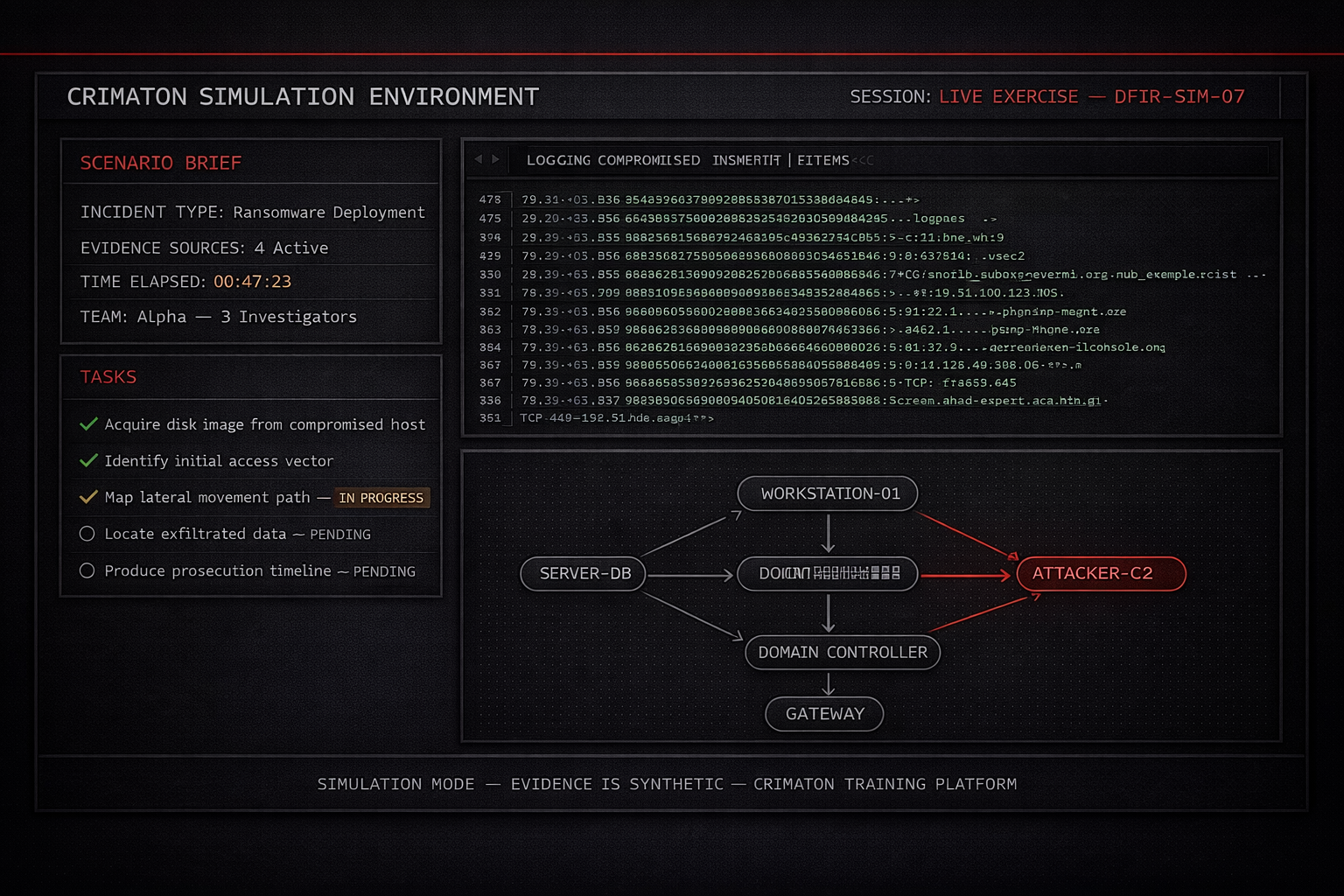
Immersive, scenario-driven training where teams respond to realistic breach simulations in purpose-built environments. Designed for security teams preparing for IR operations without the cost of a real incident.

Skill Outcomes

  • Breach detection and initial triage under operational pressure
  • Coordinated containment across multi-system environments
  • Communication protocols: technical teams to executive leadership
  • Post-incident analysis and lessons-learned documentation
  • Regulatory notification timeline management
Multi-Day Team-Based Simulation
CRIMATON simulation-based forensic training environment
Our Methodology

How CRIMATON Training Works

01

Real Case Material

Participants work through scenarios constructed from actual cybercrime and incident response case structures — sanitised for training use, but operationally authentic in their complexity and ambiguity.

02

Tool-Integrated Practice

Training is conducted within the same forensic toolsets used in production investigations. Skill transfer from training to operational environment is direct — no conceptual bridging required.

03

Structured Assessment

Each program includes checkpoint assessments and a final investigation exercise evaluated against professional forensic standards — not academic metrics.

04

Post-Training Support

Participants retain access to course materials and community resources following program completion. Professional mentorship is available for those entering career pathways.

Skill Development Initiatives

Beyond Courses — Building Investigation Capability

SDI programs extend beyond structured training to equip participants with investigation tools, operational environments, and continuous learning frameworks. Designed for individuals and institutions building long-term forensic capability.

🔧

Forensic Tool Development

Participants engage in the development cycle of CRIMATON's forensic tools — contributing to real instrument development while deepening their technical understanding of how investigation software is built and validated.

📊

Investigation-Focused Software Projects

Structured project work in which participants design, build, and test purpose-built investigation modules. Projects are evaluated against forensic integrity standards and contribute to the CRIMATON tooling ecosystem.

🌐

Simulation Environments

Access to CRIMATON's controlled investigation simulation environments for ongoing practice outside of formal training programs. Scenarios are updated to reflect current threat actor TTPs and emerging cybercrime patterns.

📚

Case-Based Learning Systems

Structured case libraries constructed from real investigation archetypes. Participants work through case resolution from initial evidence intake through prosecution referral — developing procedural fluency and investigative judgment.

🏆

CTF Competition Program

Organised Capture the Flag competitions structured around forensic investigation categories — disk forensics, network analysis, memory examination, and OSINT challenges. Individual and team formats available for ongoing skill assessment.

👥

Career Mentorship & Placement

Mentorship from active digital forensics practitioners for SDI participants pursuing careers in law enforcement, enterprise security, or forensic consulting. Structured guidance on case-building, portfolio development, and professional readiness.

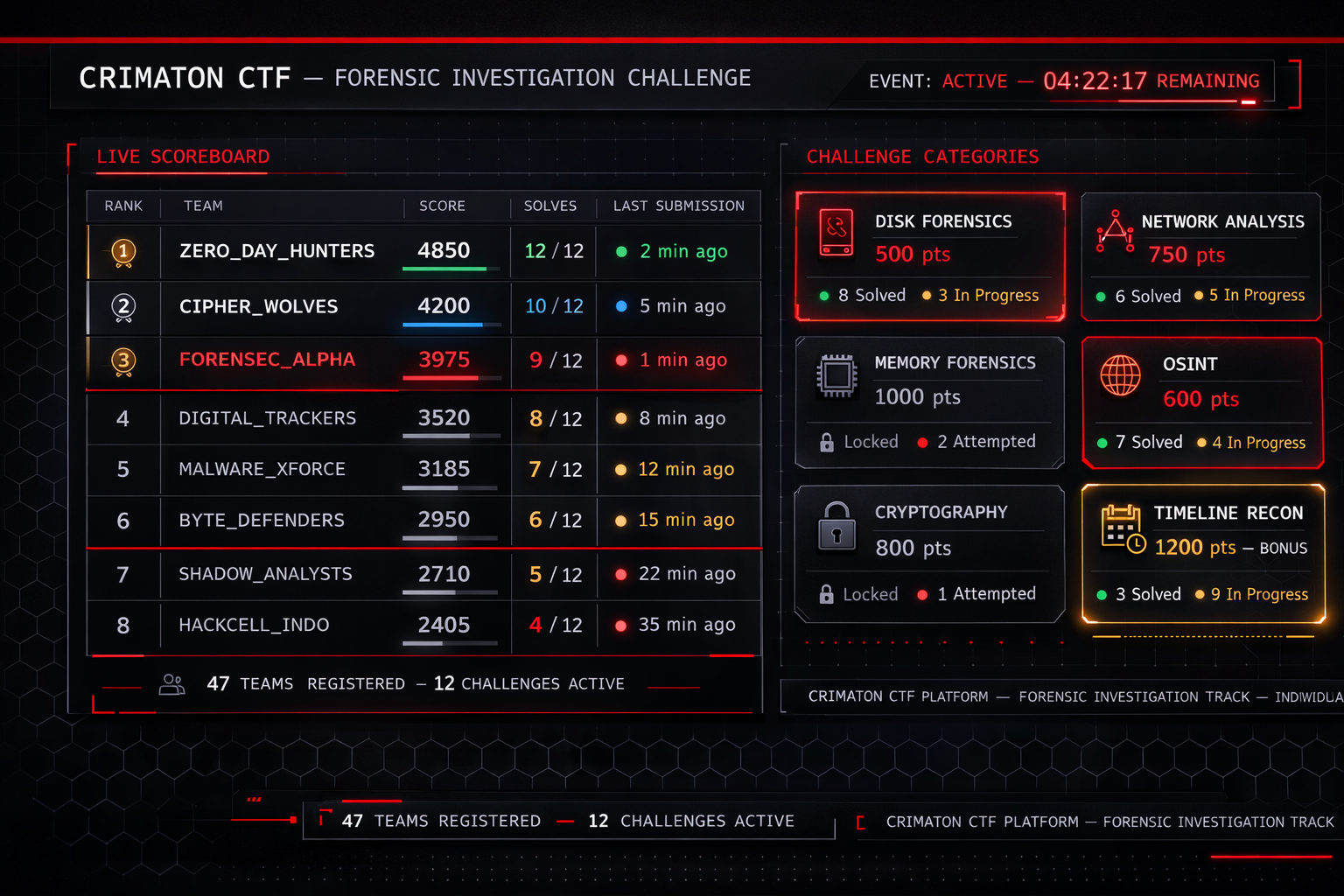
CTF Events

Capture the Flag — Forensic Investigation Competitions

CRIMATON organises structured CTF competitions focused on digital forensics disciplines. Unlike general security CTFs, our events are built around investigation scenarios — evidence analysis, timeline reconstruction, and attribution challenges drawn from real case archetypes.

Disk and file system forensics challenges
Network traffic analysis and intrusion investigation
Memory forensics and volatile artifact analysis
OSINT and digital attribution challenges
Cryptographic evidence and encoded artefact analysis
Individual and team competitive formats
Register Interest for Next Event
CRIMATON CTF Capture the Flag competition scoreboard

Training Builds Investigators. Our Software Equips Them.

Purpose-built digital forensics and DFIR software that practitioners who complete our training programs can apply immediately in operational environments.

View CRIMATON Solutions Enquire About Training